

Renewable power is not the default power source for new data centres. The reasons are not always related to the traditional problems intermittent generation.
Why Data Centres Are Turning to Gas Generation
By modern hyperscale data centre standards, Google’s new Meitner site in Texas is on the large side. When complete, it’s projected to provide 1GW of computing power, the majority of which will be fuelled by energy from wind and solar.
This one will be (mostly) powered by renewables. But the majority of data centres in operation or planned for the next five years are not. Another Google site, also in Texas, will mix 900MW of gas turbines with 250MW of renewables. In the UK, there have been over 100 requests from data centre developers for new gas connections. And in the North Sea, Orcadian Energy is planning an off-shore gas-fired power station running a 200MW off-shore data centre, with fuel extracted from gas fields nearby.
The projected speed of the Google build suggests one reason why renewables are not, on their own, enough. Meitner is predicted to be online next year, allowing 18 months from announcement to operations, a mammoth undertaking. In the UK, trade association techUK estimates a 12-24 month build time.
This is not unusual. In the business of building data centres, speed is king. The tech giants are engaged in a construction race, with the advantage going to whoever gets the most data centres built first. Amazon’s Project Rainier turned 1200 acres of Indiana farmland into an $11bn data centre in 16 months, achieving 1.6GW of output by January 2026. AWS CEO Matt Garman described it as “cornfields to data centres, almost overnight.”
The Scale of AI Data Centre Energy Demand
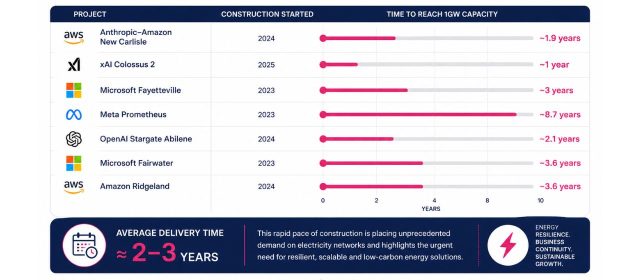
Such ambitious timelines require an energy supply that can come on stream as quickly, and supply round-the-clock power with no downtime. The availability of power is a deciding factor in where to build, with 84% of hyperscale developers (the industry term for the largest, most critical data centres) citing it as one of the top three considerations.
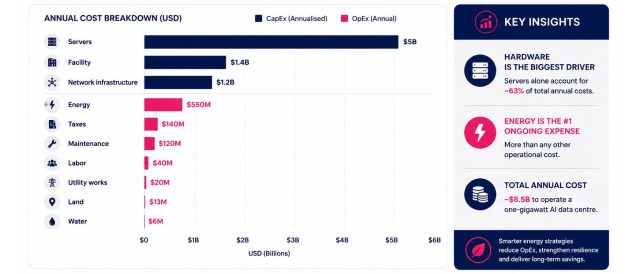
Like the scale of the sites, the energy use is also vast. When it’s completed in 2027, Microsoft’s Fairwater data centre in Wisconson is projected to use more power than Los Angeles did in 2023. But energy is a relatively small proportion of the overall cost of building and running a data centre; industry analysts Epoch suggest the annualised cost of the servers alone is $5bn. Energy, although by far the most expensive component of operating costs, is comparatively small at $590m. Clearly, developers are willing to spend a lot of money to get their projects running.
The True Cost of Powering AI Data Centres
Google’s answer has been to buy the complete package; a ready-to-build data centre which comes with its own energy park, and the company that owns it. But this is not always possible, or the energy timelines don’t allow for the incredible speed demanded by data centre developers. Even the Meitner site will not use 100% renewable power; there’s provision for what’s described as “a minority share of the site’s demand met by… on-site gas to ensure reliable operations.”
The Gas Question
For a data centre developer, natural gas has advantages. Declining demand means it’s much quicker to connect to mains gas than to the electricity grid. Gas turbines offer 24/7 power without the need for the batteries required by renewables, and offer independence from the electricity grid, with its threats of blackouts and instability.
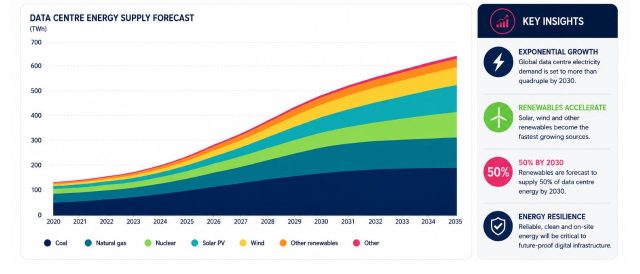
Gas is also cleaner than other fossil fuels traditionally used by generators, especially diesel. Its CO2 emissions can be trapped with carbon capture and storage technology, effectively negating local output. Its popularity in the US is, in part, also due to the Trump administration’s preference for fossil fuels; the International Energy Agency says in the US, gas is the dominant power supply for data centres, with 40% of all sites using it. Globally the figure is much lower, at 26%, but it’s on a par with renewables’ 27% share of supply.
But IEA projections suggest data centres’ gas use will level off and then decline from 2030. Although the rate of decline is minimal, as the demand for energy increases renewables are forecast to increase exponentially, making up 50% of data centre energy supply by 2030.
Renewable Energy Is the Long-Term Solution
Does this mean gas can be thought of as a necessary, short-term measure to keep the lights on? It depends on the project. In an industry where speed and capacity matter, some will use gas a bridging measure to avoid grid connection delays and get them running, with the potential to add or switch to renewables.
“Grid growth can’t match AI demand, so a pragmatic ‘all-of-the-above’ strategy is essential—with gas as a critical bridge,” Cully Cavness, cofounder and president of data centre developer Crusoe, told WIRED.
In some regions gas use for off-grid power is demanded by law. Alberta, in Canada, requires loads of over 75MW that will be connected to the grid to use natural gas generation for back up. The Alberta grid operator says this is “because of weather dependency and duration limitations” of renewables. “As of now, they are not qualified to reliably offset a data centre’s around-the-clock draw the way dispatchable gas generation can.”
How important are renewables to data centre energy?
It’s worth bearing in mind that the great data centre construction boom is a recent phenomenon. In the UK, currently home to the most data centres in Europe, capacity is set to more than double from 1.7GW in 2023 to a predicted 4.4GW in 2026. There has been a scramble among the world’s richest companies to be at the front of the race.
Governments are just starting to create a standard for these facilities, which have little specific regulation, especially concerning energy use, and are often uncertain about the scale of emissions. From 2025 to 2035, the UK government estimates data centres’ CO2 output to be anywhere between 34 and 123Mt, accounting for 0.9-3.4% of the country’s total CO2 emissions. And while proposed EU legislation is set to establish a ratings scheme for energy and water use but it’s a record of consumption, not a law designed to regulate use.
There is a full-tilt gold rush feel to the boom, sometimes with geographical parallels to the 19th century version. Storey County in Nevada, once the site of an actual gold rush in the 1850s, now contains the USA’s biggest data centre and has the state’s fastest growing economy. Energy provision and use is yet to be either standardised or regulated, and it’s possible that the data centre boom will, in fact, tip the balance in favour of renewables. Gas generation’s surge in popularity has increased the price of turbines by 195% since 2019 and there’s now a five-year lead time for large turbines, although smaller units are available within 36 months.
Already some developers run on 100% renewable power, or have developed operating models that work with the nature of renewables. Equinix says its US operations have been run on renewables since 2022, although they don’t generate it all themselves, and it “aims for 100% renewable coverage globally by 2030.” Soluna’s data centres supply computing power to match the variable nature of renewable generation, batch processing demands such as bitcoin mining when energy is abundant. This approach also helps solve the curtailment problem – the issue of switching off renewables when they generate more power than the grid can use – by acting as a giant battery, turning wind power into computing power.
At the end of the 19th century, when cars were a nascent technology, electricity, petrol and steam rivalled each other for dominance. No-one knew which would win. The car would become a defining feature of 20th century life, and the effects of the internal combustion engine would persist to the present day. Data centres are of a similar (and possibly greater) magnitude, and their energy sources have the potential to shape the rest of this century.
Planning a Data Centre Energy Strategy?
As AI infrastructure continues to grow, securing reliable, scalable and cost-effective energy has become one of the biggest challenges facing developers, operators and investors. From grid constraints and on-site generation to renewable energy integration, every project requires a strategy built around long-term resilience.
Olympus Power works with organisations across the UK to assess, design and deliver tailored energy solutions for high-demand facilities, helping businesses reduce costs, strengthen energy security and prepare for future growth.
If you’re planning a new data centre, expanding an existing facility or exploring your energy options, speak to our team today. We’ll help you identify the right solution for your project and build an energy strategy that supports your long-term objectives.
Contact the Olympus Power team today to start the conversation.
…………………………………………..
FAQ Section for the Article
How can renewable energy support AI data centre development?
Renewable energy can help AI data centre developers reduce exposure to volatile electricity prices, lower operational emissions and strengthen long-term energy resilience. The right solution may combine on-site generation, battery storage, grid electricity and carefully structured energy procurement.
Can a data centre run entirely on renewable energy?
A data centre can be supplied with renewable electricity, but achieving continuous 24-hour renewable operation is more complex. Energy demand, grid availability, generation profiles, storage capacity and backup requirements must all be assessed during the development process.
What energy solutions are available for new data centres?
Options can include solar PV, battery energy storage, renewable power purchase arrangements, private wire connections, on-site generation, grid optimisation and energy efficiency measures. The most suitable combination depends on the site, power demand, development timeline and commercial objectives.
Why is energy planning important when developing an AI data centre?
AI data centres require substantial and reliable power capacity. Early energy planning can help developers identify grid constraints, evaluate alternative generation routes, understand costs and design infrastructure that supports future expansion.
When should commercial developers begin planning a data centre energy strategy?
Energy planning should begin during the earliest feasibility and site-selection stages. Engaging an energy specialist early gives developers more time to assess grid capacity, planning requirements, generation opportunities, funding structures and delivery risks.
How can Olympus Power support data centre developers?
Olympus Power can support commercial developers in assessing energy requirements and exploring appropriate generation, storage, optimisation and funding solutions. The team works as a strategic energy partner, helping organisations develop resilient and commercially viable energy strategies.