
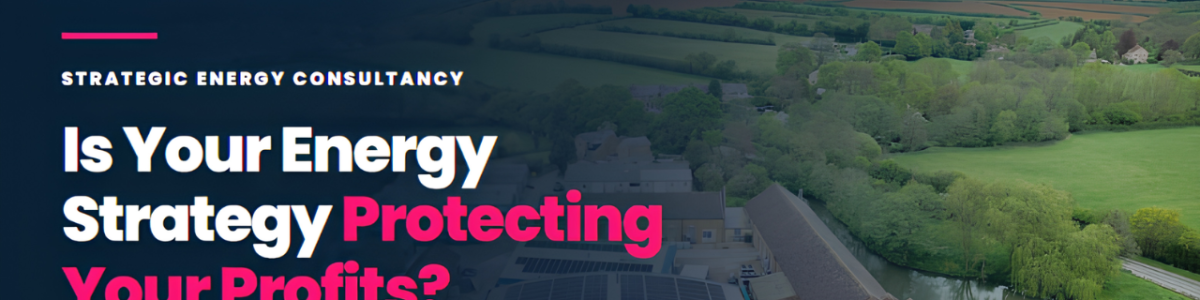
How much is your business spending on energy, and how much of that expenditure is genuinely necessary?
It’s a question every CFO, Managing Director and Operations Director should be able to answer.
But knowing what appears on the electricity bill isn’t the same as understanding the true commercial impact of energy across your business.
Energy influences operating margins, investment decisions, production costs and long-term financial resilience.
So, before signing another supply contract or committing capital to new infrastructure, there are five questions worth asking.
1. Are We Paying More for Electricity Than We Should?
When did your business last properly review its energy expenditure?
Not simply compare suppliers or renew a contract, but examine how electricity is purchased, consumed and managed across your operations.
- Are your procurement arrangements aligned with your actual consumption?
- Do you understand the different components of your electricity costs?
- Are your current contracts exposing you to avoidable financial risk?
- Could changes to your energy infrastructure reduce your reliance on purchased electricity?
For energy-intensive businesses, relatively small improvements in the cost of each unit consumed can have a meaningful impact on annual expenditure.
The starting point isn’t necessarily finding a cheaper tariff. It’s understanding where the money is going.
2. How Much Profit Are We Losing Through Energy Inefficiencies?
What happens to your electricity consumption when production stops?
Are your buildings consuming unnecessary energy outside operating hours?
Could voltage optimisation, better monitoring or changes to equipment operation improve efficiency?
These questions matter because energy waste doesn’t always appear as an obvious problem.
It can be buried within normal operating expenditure, accepted as a fixed cost or overlooked because no one has examined the data closely enough.
A commercial energy assessment can help identify opportunities that might otherwise remain hidden.
The objective is straightforward: reduce unnecessary expenditure without compromising productivity, safety or operational performance.
3. What’s Our Financial Exposure to Future Energy Price Increases?
If your electricity costs increased significantly over the next 12 months, what would happen to your operating margin?
Could you absorb the additional expenditure?
Would you need to increase customer prices?
Would investment plans be delayed?
And how much control does your business currently have over its exposure?
Energy price volatility isn’t simply a procurement issue. For many organisations, it’s a financial planning and risk management challenge.
Businesses should understand the relationship between their energy contracts, consumption patterns, on-site generation opportunities and long-term operating requirements.
The goal isn’t to predict the next price movement.
It’s to build a business that is better prepared for it.
4. Are We Investing in the Right Energy Infrastructure?
Would a major energy investment improve your financial position, or simply create another capital commitment?
Before investing, directors should be asking:
- What is the expected payback period?
- How much expenditure could the project avoid?
- How sensitive are the projections to changes in electricity prices?
- What are the operational implications?
- How does the investment support our wider business strategy?
The right solution will depend on the site, the organisation’s financial position and its energy requirements.
For some businesses, the priority may be procurement or operational efficiency.
For others, on-site generation, battery storage, voltage optimisation or infrastructure upgrades could present a stronger commercial opportunity.
The technology should follow the business case, not the other way around.
5. Could Our Energy Budget Be Working Harder?
What would your business do with an additional £50,000 or £100,000 in annual operating cash flow?
Invest in equipment?
Recruit additional staff?
Increase production capacity?
Strengthen your balance sheet?
Reducing energy expenditure can release resources for other commercial priorities.
That’s why energy strategy deserves attention at board level.
And it’s why businesses should assess energy decisions in terms of profitability, resilience and return on investment, rather than treating them solely as sustainability initiatives.
Case Study: How Gooch & Housego Took Greater Control of Energy Costs
For hi-tech manufacturer Gooch & Housego (G&H), energy expenditure represented a significant operational challenge.
The business, which serves the aerospace, telecommunications and life sciences sectors, was facing electricity bills of approximately £50,000 per month at its Ilminster headquarters.
Rather than simply accepting increasing energy expenditure, G&H explored opportunities to reduce its reliance on purchased electricity.
Following a successful Olympus Power installation at its Torquay site, the manufacturer commissioned a further project at Ilminster.
The business challenge
G&H needed to address three connected priorities:
- Reduce substantial electricity expenditure
- Improve protection against future energy price increases
- Support its existing sustainability and net zero objectives
The solution
Olympus Power installed a 300 kWp rooftop solar system comprising 790 panels across the building’s two roofs.
The system was designed to generate up to 300,000 kWh of electricity annually.
On clear days, it could provide approximately 25% to 35% of the site’s electricity requirements, reducing the amount purchased from the grid.
The projected financial impact
The project’s published figures included:
Up to £12,000 per month in electricity savings
Up to 300,000 kWh of annual electricity generation
An estimated investment payback period of within three years
These were the savings and payback expectations reported in the original project case study, rather than independently verified current financial results.
For G&H, the commercial value extended beyond reducing the electricity bill.
Greater control over part of its energy supply also supported longer-term financial planning and its sustainability strategy.
Read the full Gooch & Housego case study
What Could a Better Energy Strategy Deliver for Your Business?
G&H’s experience demonstrates the value of examining energy expenditure as a commercial opportunity.
But the same solution won’t be right for every organisation.
A manufacturer operating energy-intensive equipment has different requirements from a distribution centre, commercial landlord or hospitality group.
The important questions are:
Where are your biggest energy-related costs and risks?
Which opportunities could produce a meaningful financial return?
What changes are commercially and operationally viable?
And who is helping you connect those decisions into a coherent long-term strategy?
These are the questions that should come before any recommendation to invest.
More Than an Energy Consultancy. Your Strategic Energy Partner.
At Olympus Power, we help commercial and industrial organisations make better-informed energy decisions.
Our approach starts with understanding your business, its operating requirements and its commercial objectives.
From there, we can assess opportunities across energy procurement, efficiency, monitoring, renewable energy infrastructure and longer-term energy planning.
We support businesses from initial consultation and feasibility through to project delivery and ongoing optimisation.
Not every business needs a major infrastructure investment.
Some need greater visibility over consumption. Others need to reconsider procurement arrangements, identify inefficiencies or develop a longer-term plan for energy resilience.
The priority is finding the right commercial approach for your organisation.
Book Your Energy Consultation
Are you confident your current energy strategy is delivering the best possible outcome for your business?
If you can’t answer that question with evidence, it may be time for a closer look.
Speak with Olympus Power about your energy expenditure, operational challenges and long-term business objectives.
Book your energy consultation today.
Olympus Power: More than an energy consultancy. Your strategic energy partner.