

Sustainable Data Centre Development Is the Key to Building Public Trust
The data centre boom is creating a parallel growth industry: opposition to itself.
Across the UK, Europe and the United States, communities are increasingly questioning the impact of new data centres on electricity consumption, water resources, carbon emissions and local infrastructure. As artificial intelligence accelerates demand for digital infrastructure, sustainable data centre development has become just as important as technological innovation.
For developers, the challenge is no longer simply delivering capacity. It is demonstrating that data centres can be designed, powered and operated responsibly while supporting the communities around them.
Opposition to Data Centre Development Is Growing
It has been a tricky year for data centre development.
In the US, 75 projects worth $130 billion were blocked or delayed by local opposition during the first three months of 2026 alone. Data Center Watch, which tracks local opposition to data centre developments, says this is the largest single-quarter concentration of blocked and delayed projects on record.
New York Governor Kathy Hochul has halted new data centre developments while concerns around water consumption and electricity costs are investigated.
The UK has experienced similar challenges, with proposed developments in Devon, Norfolk, London and the Scottish Borders all facing organised opposition from local campaign groups.
These are no longer isolated protests.
Bloom Energy’s latest survey of hyperscale developers found that 28% of respondents believe community scrutiny has increased significantly during the past six months and is becoming a growing obstacle to development.
Poor planning can have significant consequences.
Campaigners successfully challenged a Buckinghamshire data centre after concerns around climate impacts were not properly addressed during the planning process. The Government ultimately accepted that the assessment should be reconsidered.
Fast-tracking planning applications while overlooking community concerns is proving counterproductive. Sustainable data centre development requires transparency, engagement and long-term planning from the outset.
Energy Has Become the Battleground
For many developers, energy strategy is now the defining component of a successful data centre project.
It has also become the focal point for public acceptance.
After abandoning a proposed development in Wisconsin following community opposition, Microsoft introduced its five-point Community First Infrastructure Framework.
The first commitment focuses on how electricity is sourced and managed.
Microsoft acknowledged that communities welcome investment, jobs and economic growth, but not if those benefits come at the expense of higher electricity prices or additional pressure on local infrastructure.
Electricity demand continues to grow rapidly.
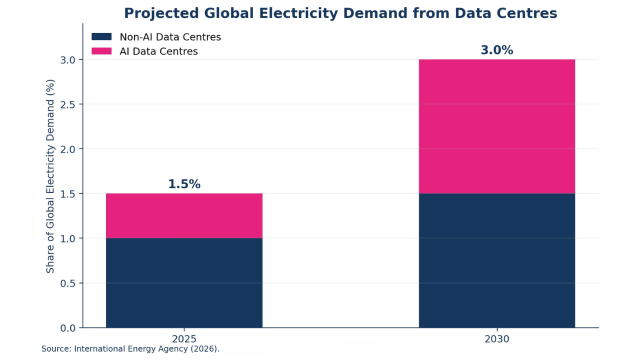
Today, AI-focused data centres consume approximately 0.5% of global electricity while traditional data centres account for around 1%.
By 2030, both figures are expected to reach approximately 1.5%, meaning data centres could consume around 3% of the world’s electricity.
While these percentages appear modest, they disguise significant regional concentration.
In Ireland, data centres already account for around 21% of national electricity demand.
Across the United States they consume around 4% nationally, but in Virginia that figure rises to approximately 25% of the state’s electricity usage.
As demand becomes increasingly concentrated, regulation is following.
Virginia has introduced the first state-wide tax on data centre electricity consumption, while more than 260 pieces of legislation relating to data centres were introduced across US state legislatures during 2026.
Sustainable Data Centre Development Starts With Energy Strategy
As demand continues to accelerate, renewable energy is becoming central to successful data centre development.
At Olympus Power, we believe energy strategy should be considered from the earliest stages of planning rather than introduced later in the development process.
A holistic approach enables developers to assess renewable energy generation, battery energy storage systems (BESS), grid capacity, energy procurement, carbon reduction and long-term operational resilience as one integrated strategy.
By addressing energy infrastructure early, developers can often strengthen planning applications, improve long-term commercial performance and demonstrate meaningful environmental responsibility.
No two developments are identical.
Every project requires an energy strategy tailored to its operational requirements, financial objectives and sustainability goals.
Brownfield Development Can Improve Community Acceptance
Brownfield sites are not suitable for every project.
Existing buildings may lack sufficient structural strength, available grid capacity or physical space for hyperscale facilities.
However, where appropriate, brownfield regeneration offers wider community benefits by bringing disused sites back into productive use while reducing pressure on undeveloped land.
The evolution of AI is also changing how data centres are designed.
Consultancy Analysys Mason believes inference computing, where AI responds directly to users in real time, is driving demand for facilities located closer to population centres.
Equinix already operates dozens of metro-edge facilities, including sites across London such as Park Royal and Harlesden.
In Beijing, Spark761 demonstrates how data centres can become part of everyday communities rather than isolated industrial compounds.
Located within the city’s creative district, the development incorporates co-working space, public exhibition areas and even a café, helping create transparency and public engagement.
Making facilities part of the community rather than separating them from it can significantly improve public perception.
Better Design Creates Better Data Centres
Good design delivers more than aesthetics.
Stone Cloud in Sweden demonstrates how architectural decisions can improve energy efficiency by using granite as a natural thermal insulator while increasing the building’s long-term adaptability.
Similarly, South Korea’s Gak Chuncheon facility uses natural airflow from surrounding mountains to minimise mechanical cooling, requiring artificial cooling for only around 35 days each year.
Green roofs cover half of the development, further reducing environmental impact.
These projects demonstrate that sustainable data centre development extends beyond renewable energy generation.
Building materials, passive cooling, landscaping and future adaptability all contribute to reducing long-term environmental impact.
Turning Waste Heat Into Opportunity
Data centres generate significant amounts of waste heat.
Although much of it is relatively low temperature, it can still provide valuable heating for nearby buildings and agricultural facilities.
UK developer Blaq Cat has designed modular data centres that use waste heat to warm commercial glasshouses, allowing food production and digital infrastructure to operate together.
In Sweden, surplus heat from an existing data centre is used to grow cucumbers inside the Arctic Circle.
Elsewhere, Finland’s atNorth facility supplies almost all the heating required by a neighbouring supermarket.
Leafcloud has taken this concept even further by installing server infrastructure directly inside buildings including hotels and care homes, transferring heat into domestic hot water systems.
As computing becomes increasingly decentralised, opportunities to recover waste heat are likely to expand significantly.
Data Centres Need More Than Electricity. They Need Public Confidence.
No single innovation will eliminate every concern surrounding data centre development.
However, collectively these examples demonstrate that better planning, stronger energy strategies and greater transparency can address many of the issues driving public opposition.
Like the National Grid before them, data centres represent critical national infrastructure that will shape economic growth for decades to come.
As AI continues to transform industry, sustainable data centre development will depend not only on technological capability, but on creating facilities that communities are prepared to support.
At Olympus Power, we help developers take a holistic approach to energy planning by integrating renewable energy, battery storage, carbon reduction strategies and long-term energy resilience into every stage of the development process.
Book Your Complimentary Energy Strategy Consultation
Planning a new data centre development?
If you’re designing a hyperscale campus, edge computing facility or AI-ready infrastructure, Olympus Power can help you build a commercially viable and sustainable energy strategy from concept through to operation.